About this time of year, I get many walk-ins and phone calls about a weed that “just took off overnight, and it’s all over my yard.” If this weed is in clusters with pretty purple flowers coming out of the top then you have Henbit in your yard.
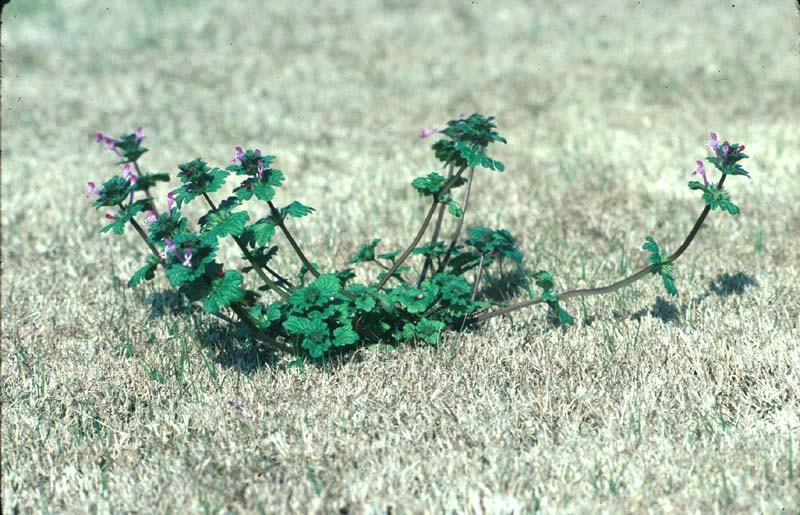
Henbit is a sparsely hairy winter annual with greenish to purplish, tender, four-sided stems. Similar in appearance to purple deadnettle, but the upper leaves lack petioles. Leaves opposite, broadly egg-shaped with bluntly toothed margins, and prominent veins on the underside. Flowers, reddish-purple with darker coloring in spots on the lower petal, are arranged in whorls. Reproduces by seed. Found throughout most of North America. Also occurs in the West Indies, South America, Europe, Africa, Asia, and Australia.
Control Options
Once your lawn has a purple shade to it from the henbit flowers, it is too late to do much good. As our winter annuals get closer to maturity, it becomes harder to control them. Controlling winter annual weeds early will reduce the amount of work you have to do later and reduce the seedbank for subsequent years. Although we have some really good herbicides, the timing of application is critical for acceptable control without repeated and costly applications. Applying a herbicide or herbicides in the fall will help reduce or eliminate your need to do anything in the spring. There are several products that we can employ in this type of weed control strategy.
For centipede and St. Augustine, we can use atrazine in the fall to control most of our problem weeds. The cautions for atrazine use are not to overapply and not apply during spring green-up. For those with Bermudagrass, atrazine can be used once it is completely dormant. For those of you with either Bermudagrass or zoysia, you have some options as well. All of those products that are advertised for crabgrass control can be used to control several winter annuals. Products with active ingredients such as pendimethalin, oryzalin, and benefin are good products that will control annual bluegrass, chickweed and henbit. Dithiopyr, which is in Turf & Ornamental Weed & Grass Stopper, controls a few more weed species, but might be harder to find. For longer control a 2nd application may be necessary. These products will also work on centipede and St. Augustine.
You can apply a 3-way herbicide mix and kill almost any broadleaf weed in the lawn. The only thing you need to be careful with is using them near ornamentals and the rates on St. Augustine and centipede. Centipede grass is sensitive to 2,4-D, St. Augustine is sensitive to dicamba, and both products can injure ornamentals.
Contact your County Agent for more information on winter annual weed control.
